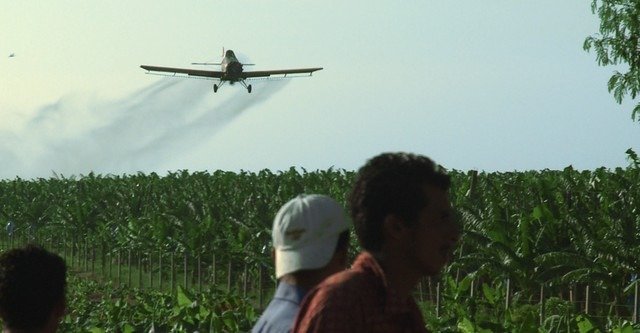

In the Nicaraguan city of Chinandega, a young man watches as his father’s body is lowered into the ground. Holding back tears, he can’t help but think about the silent killer: pesticides used on the banana plantation where his father spent decades working.
This is the opening scene of Bananas!, a 2009 documentary by Swedish filmmaker Fredrik Gertten that follows a group of 12 Nicaraguan banana plantation workers, known as “bananeros,” and their Cuban-American lawyer, Juan Dominguez, as they sue the multinational produce company Dole. The lawsuit targeted the use of the agricultural pesticide DBCP, which caused severe health problems among the workers.
When Bananas! was filmed, thousands of former bananeros were suffering long-term health effects of DBCP exposure, including sterility, cancer, and chronic illness. Many had joined protest camps outside Nicaragua’s National Assembly, living in makeshift tents for years to demand recognition and compensation. Although DBCP was banned in the United States, Dole continued using it in Nicaragua through the 1970s and early 1980s, taking advantage of weak labor protections and the country’s post-war economic vulnerability.
The push for justice unfolded alongside the rise of the Sandinista National Liberation Front (SNLF), a leftist movement supported by farmers, students, and the middle class. The Sandinistas promoted land redistribution, education, and healthcare, yet the state, pressured by foreign investment and mounting public outrage, failed to protect the bananeros.
That failure forced the workers to seek justice independently in U.S. courts and, eventually, through the visibility brought by Gretten’s film. Dominguez became involved in 2004, when he filed the first American lawsuit against Dole in the Los Angeles Superior Court, leading to the trial in 2007.
The film screened Oct. 7 at Kino Atlas as part of the non-competitive program at the second annual Press Play Prague: An International Film Festival About Journalism. At a festival about journalism under pressure and its role as a democratic gatekeeper, Bananas! stood out as an example of the kind of truth-driven reporting and filmmaking the festival aimed to celebrate.
Beyond exposing corporate negligence, the documentary raised urgent questions about the risks faced by journalists and filmmakers when holding billion-dollar institutions (roughly 25 billion Czech crowns) accountable.
After Bananas! premiered, Dole sued Gertten for defamation, claiming he misrepresented the company’s role and portrayed Dominguez as a “crook.” The lawsuit became both a challenge to the film’s claims and a warning to others who wanted to confront gigantic corporations like Dole. Though the case was ultimately dropped, Gertten was forced to defend his credibility rather than the bananeros’ reality, a tactic used by Dole to shift attention from corporate accountability to the filmmaker’s supposed bias.
Gertten continued the story with Big Boys Gone Bananas!, released in 2011 and screened at the festival the following day. The follow-up chronicles not only the legal battle with Dole but also the global backlash against the original Bananas!, including efforts to suppress it and discredit Gertten personally. By highlighting corporate power and censorship, the sequel reveals the high stakes of investigative storytelling, showing how documenting injustice can provoke legal and financial pressure while emphasizing the importance of protecting truth.
Following the screening of Bananas!, Press Play Prague hosted a discussion with Gertten to debate the impact of the film. Many pointed to it as a case study in strategic litigation, where corporations sue less to win than to intimidate.
Gertten noted that while social justice is not always achievable in court, documentary films can expose injustice and shape public awareness. The discussion also explored the risks of spotlighting figures like Dominguez, which can create hero narratives and overshadow the bananeros’ agency. Still, Gertten defended the importance of human-centered storytelling: anchoring injustices in individual experiences allows the audience to follow and emotionally invest in the story.
Though Bananas! was not part of the main competition, its screening sparked crucial conversations about the rights and responsibilities of journalists worldwide. The film illustrates the balance between storytelling and accountability, revealing how filmmakers can navigate legal threats, corporate pushback, and ethical dilemmas.
More than a documentary about a pesticide lawsuit, it serves as a testament to the power of investigative journalism, reminding audiences that documenting the truth is rarely easy, but always essential.
Just as Dominguez rallies the bananeros with “United? We will win!”, the phrase now echoes beyond Chinandega, reflecting Gertten’s own battle to defend truth and accountability.