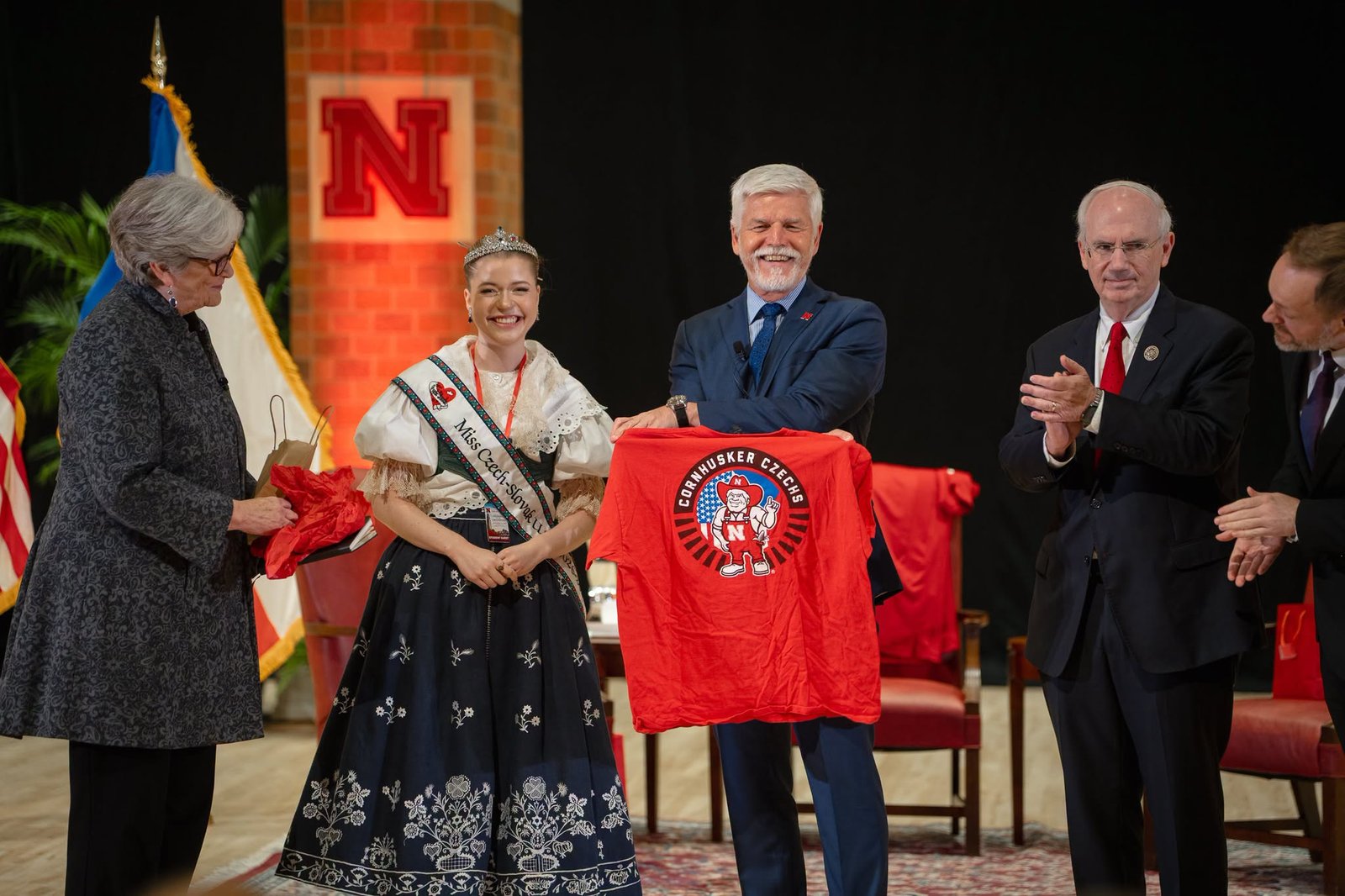

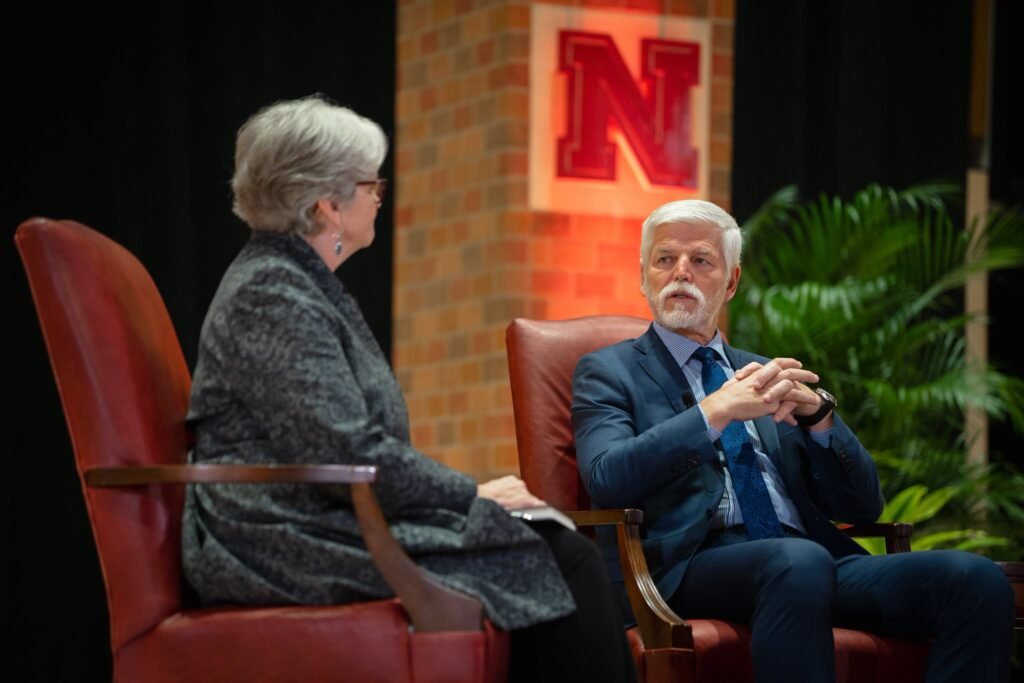
Czech President Petr Pavel visited Wilbur, Nebraska, the official Czech capital of the USA and University of Nebraska, after his trip to the United States for the UN General Assembly in New York City.
He was greeted with a warm welcome of traditional Czech costume, dance and food. Additionally, he met with Nebraska’s governor as well as various Czech officials within the United States.The Czech president received a city key and had a day designated in his honor.
“I am rarely moved to emotion, but in Wilbur […] it was impossible not to be,” Pavel said on social media.
Wilbur received its official Czech capital designation by then-president Ronald Reagan in 1987 with about 90% of its 1,250 residents having Czech ancestry. The small town takes great pride in this fact, with street signs in both English and Czech, offerings of koláče at local bakeries, and a popular annual festival celebrating traditional dress and music.
Outside of Wilbur however, Czech identity is seemingly minimal in the United States. About 0.35% of the population identifies as being of Czech ancestry, per the U.S. census. Compared to other European ethnic groups of similar populations, such as Greek (0.4%), there is a less obvious influence on the broader American culture. To the sizable number of Anglo-American students from the United States, the connection between their home country and the one that they live in might not be so apparent.
Czech influence has subtly manifested itself in American culture however. The first major immigration of Czechs to the United States came in 1848 and peaked during the early 20th century, predominantly into agricultural opportunities in the Midwest. Nazi occupation and subsequent Soviet influence would further drive people to the US.
Texas also has a sizable Czech population, dubbed Czexans, that have had a fairly notable impact on the culture. Polka, a traditionally Bohemian genre, made its way to Texas and Northern Mexico in the late 19th century where it melded with Mexican music. Listeners can hear obvious similarities between Polka and genres like Norteño and Tejano. Instruments like the tuba and accordion that are frequently used in Mexican brass bands were brought over from Europe.
Czech beer-making processes also gained popularity in the United States and Mexico, leading to the prominence of Pilsner style beers. Budweiser, one of the most popular American beer brands, took its name from the Czech lager that inspired its creation.
President Pavel’s recent visit to the United States reaffirms the historic tie between the two countries, and a culture that has survived far from its little country of origin.