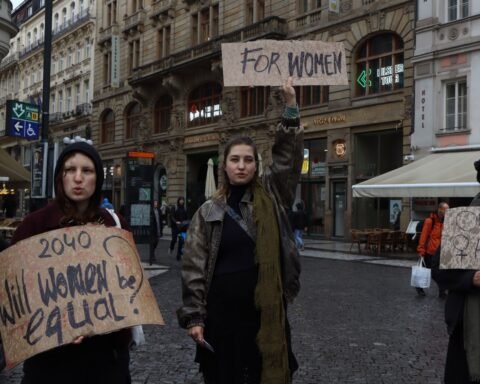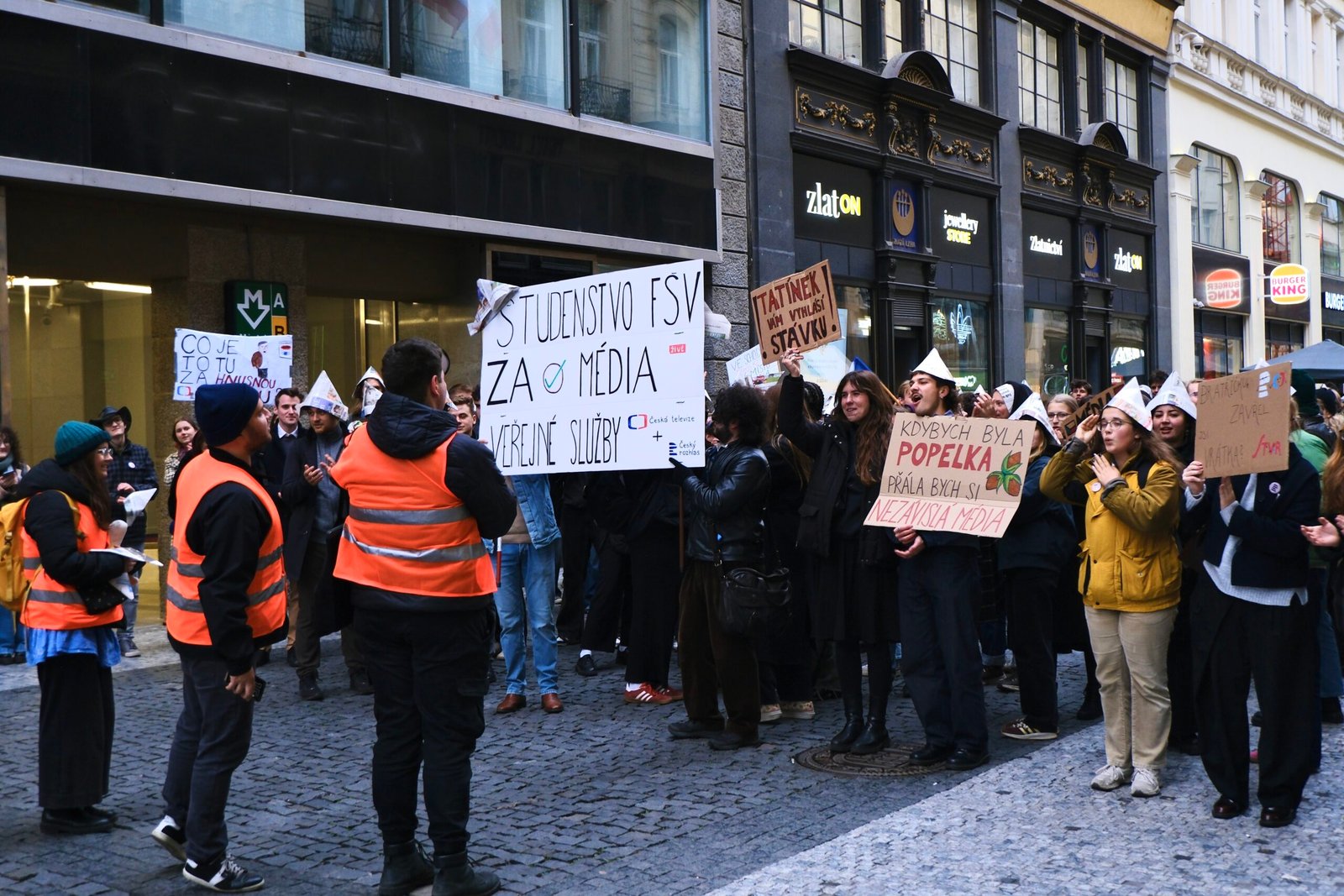

Protesters demonstrated all around the Czech Republic on Nov. 3 in support of nearly all Czech Television and Radio employees going on strike for the day. Adorned in newspaper hats, thousands of people came together to oppose a new law impacting Czech Television and Radio funding. Various journalistic organizations, universities and student organizations contributed to the protests.
“It’s not only for the television, but against the way the government is leading our country,” said Adela, 19, a Social Sciences student from Charles University walking with her fellow classmates to the demonstration.
In an act that some have called “revenge” for recent disastrous election results for Czech Prime Minister Andrej Babiš’s coalition parties, the Chamber of Deputies speed-ran the first round of talks regarding a law that would shift the financing of Czech Television and Radio from public licensing fees to the state budget on Oct. 23. The move came just one week after Czechia’s 2026 municipal and senate elections.
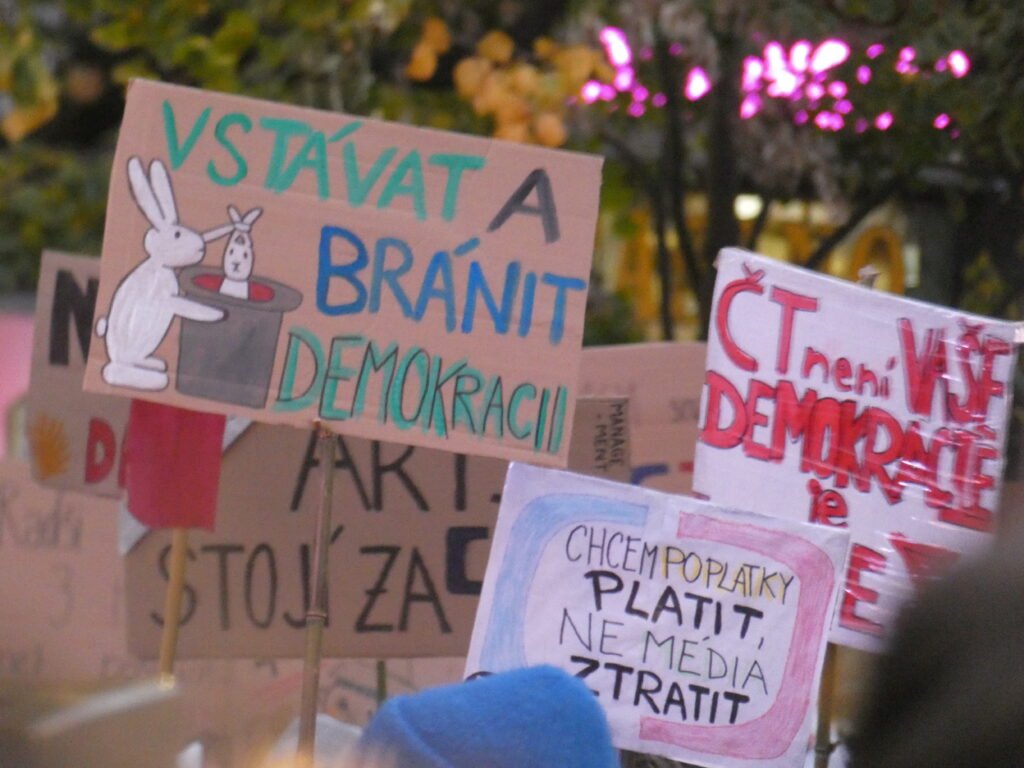
The proposed law would shift Czech Television and Czech Radio funding from licensing fees, under which households pay 205 CZK (~$9.44) per month, to the state budget. Should the law go into effect, Czech Television and Czech Radio would lose around 1.4 billion CZK from their budgets respectively, effectively returning the budgets of Czechia’s two national broadcasters back to levels last seen in 2024 and 2008.
On Friday, Oct. 23, the Babiš majority government in the Chamber of Deputies, composed of ANO 2011, SPD and Motoriste sobě (motorists for themselves), voted to continue a session discussing Czech TV and Radio financing late into the night.
The decision led protestors to amass outside and near the chamber of deputies building on Sněmovní street next to Malostranské Náměstí in Prague 1. At one point during the evening, some protestors entered the observation deck inside the Chamber of Deputies without permission while the discussion was ongoing to peacefully display a banner. The peaceful protestors were then forcefully removed from Parliament.
While under guard, the Chamber of Deputies continued to discuss the controversial funding law, with hundreds of protestors waiting outside parliament until the passing vote was conducted at 4:36 a.m. Saturday, Oct. 24. PM Babiš was apparently absent at the time the vote took place.
Opposition parties in Parliament heavily criticized the meeting and subsequent vote that passed the first round of talks, arguing that long-standing customs and traditions in the chamber were not followed by the Babiš coalition, citing such examples as speaker of the Chamber of Deputies Tomio Okamura (SPD, part of the Babiš coalition) denying breaks to opposition parties to discuss during the all-night session or refusing to turn on microphones to allow opposition MPs to speak.
Opposition parties in the chamber argued that, because 65 legislators did not get the chance to speak preceding the vote, the passing of the law would not hold in the Czech Constitutional Court, violating precedent.
“They have demonstrated a violation of every existing principle. They have shown contempt for the people of this country–and that will come back to haunt them.” said Vít Rakušan, leader of one of the biggest opposition parties, STAN (Starostove a Nezavislosti – Mayors and Independents).
The same day, President Petr Pavel posted a statement on X (formerly known as Twitter), calling for a cooling of tensions between political parties.
“I call upon politicians to calm their emotions, return to substantive debate, adhere to established parliamentary rules, and restore basic respect between the coalition and the opposition. I ask for democratic conduct and dignity. I believe the public expects the same from their politicians.”
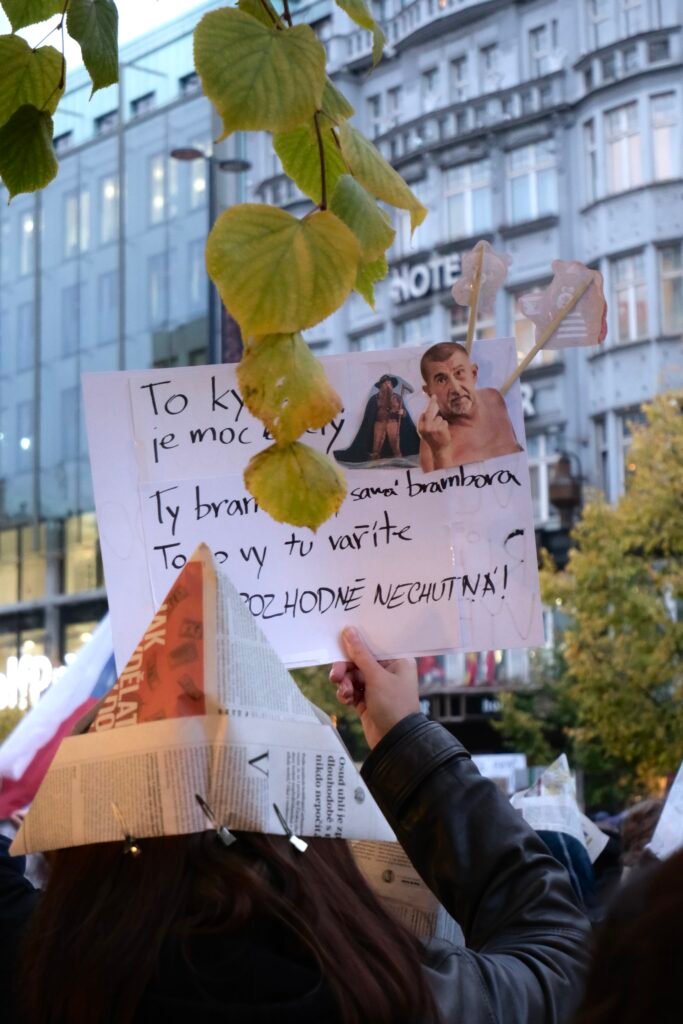
Later on Oct. 24, thousands of Czechs took to the streets across the nation from Prague to Brno in protest of what they see as the government infringing on freedom of the press and subsequently freedom of speech.
Affiliated organizations came to aid Czech TV and Radio over the weekend as well, with theatres across the country announcing their support. On the popular TV show Star Dance on the night of Oct. 24, the show’s moderator started with a comment on the previous night’s events that occurred in the Czech Parliament.
Organizations not affiliated to Czech TV came to their support as well. Prague Integrated Transport company posted on social media an image of a tram in front of the Czech Radio building with the time of the controversial parliamentary vote on it, a slightly cryptic message in support of Czech Radio.
The time the vote took place – 4:36 a.m. – was heavily criticized by opponents of the law. Milion Chvilek pro demokracii (A Million moments for democracy) likened the time of vote on Saturday morning to around the same time when Czechoslovak Radio first announced the Warsaw Pact invasion of Czechoslovakia on Aug. 21 1968.
In a video posted to X (formerly known as Twitter) on Oct. 24, the PM said that the opposition should “stop inflaming tensions and trying to break apart people”, likening the peaceful protests on front of the chamber on October 23 to the violent insurrection in the U.S. capitol on Jan. 6, 2021.
Nationwide protests against the law continued into Sunday Oct. 25, with a particularly large gathering of thousands of protesters in Prague on Old Town Square, organized by Milion Chvilek pro Demokracii, demanding that the Babiš coalition repeal their controversial law. During the protest, lead organizer Mikuláš Minář invited the PM to a public debate on public media, to which Babiš declined.
At the end of the protest, around 40 famous figures in Czech media and film came on stage announcing their support for Czechia’s public broadcasters including Eva Holubová, known for her roles in iconic Czech films such as Pelišky.
In spite of the large protest on Oct. 25, at which thousands attended, PM Babiš refused to back off from his stance at a press conference on Oct. 26 before a state visit to Algeria.
“Politicians can currently decide on the level of the fees. The new model we are proposing will limit their direct influence. We will never interfere in the editorial work of Czech Television and Czech Radio, nor in their personnel matters,” the PM said.
During the conference, Babiš accused Milion chvílek Pro Demokracii of sharing his phone number with the public, and that he received “about 6,700 messages”, some of which he claimed were violent. Million Chvílek subsequently denied these accusations and others against them such as “the association…sowing division in society”
According to the chamber of deputies timeline and Babiš, the second reading of the proposed media law will be held in January. “We will not restrict the second reading at all; let everyone say whatever they want.” the PM said. The law, should it pass, will take effect some time next year according to current timelines.
In another update attempting to reassure the public of his government’s plan on public media financing on Nov. 4, Babiš claimed that the revisions he made to the media law were what the European Commission wants, and that the law wouldn’t be revised if passed until after his government’s electoral term ended.
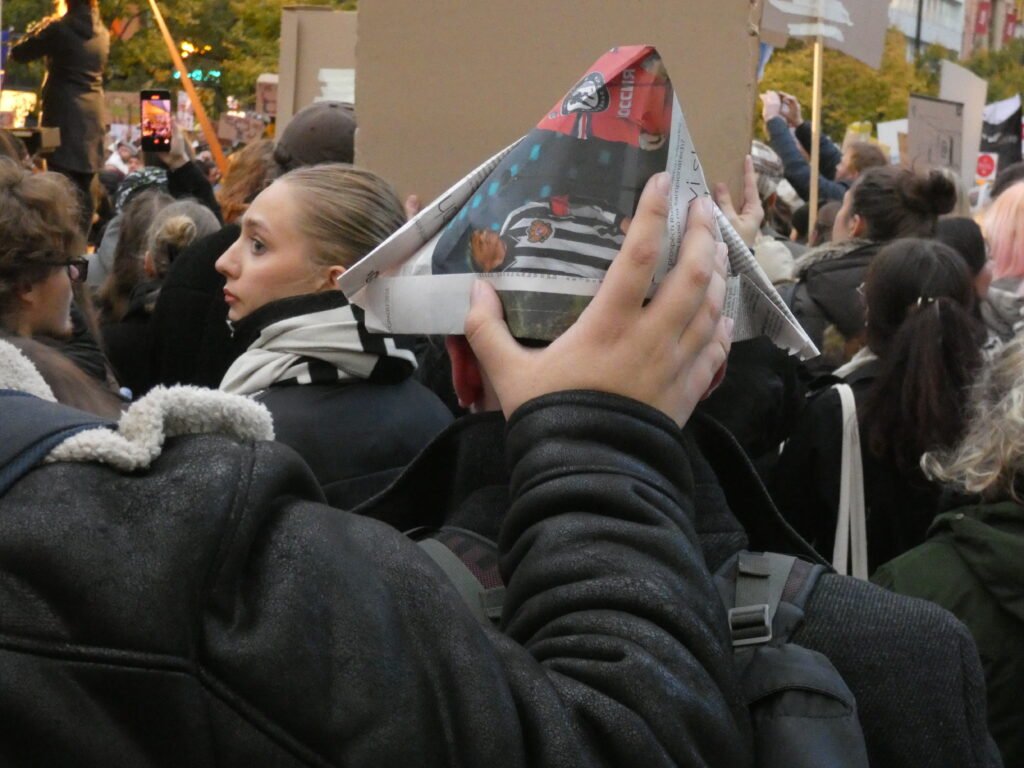
However, an article published on novinky.cz a day earlier claimed that the European Commission was “assessing their response” and that it was closely monitoring the situation, which differed from Babiš’ later claim saying that they supported the law or the changes made to it.
Milion chvílek pro demokracii has another major protest in support of Czech TV and Radio planned for Nov. 15 at Letná park. Whether or not the Babiš government will change the law regarding the financing of Czech public media as promised remains to be seen following the past weeks events.